
One Side Gets Viagra. The Other Gets Told It’s Ageing.
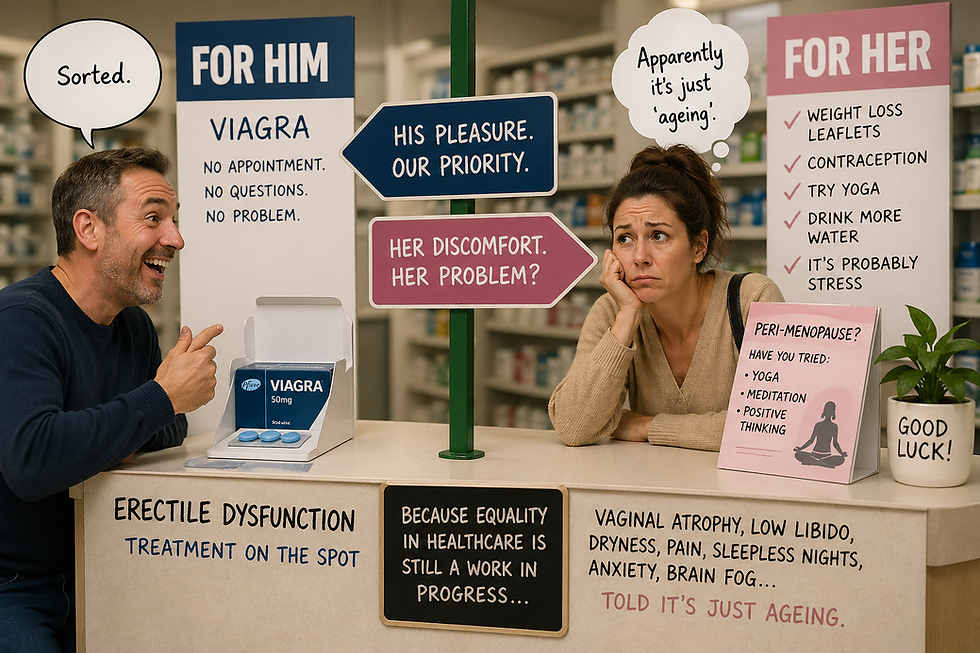
I was in Boots the other day, doing what most people do, popping in for one thing and leaving with three others I didn’t need.
And there it was.
Right there on the counter.
Viagra.
No fuss. No awkward conversation. No long explanation about lifestyle, stress levels, or whether you’ve “considered going for a walk more often.”
Just a straightforward, normalised treatment for erectile dysfunction sitting next to the chewing gum like it’s completely unremarkable.
For men: Here are your options. Let’s sort it.
For women? Weight loss leaflets. Contraception. And the subtle undertone of “have you tried not being so tired/stressed/emotional?”
Because apparently that’s the full spectrum of women’s health.
The reality in my clinic
Around 90% of the women I see in their 40s and beyond are presenting with very clear signs of perimenopause.
Not vague symptoms. Not “maybe.”
Clear, textbook hormonal change.
We’re talking:
Sleep disruption
Anxiety that feels new and unfamiliar
Brain fog
Cycle changes
Joint pain
Fatigue that doesn’t improve with rest
Weight changes that feel completely out of character
And yet, out of all of those women, only one had been offered HRT by her GP.
The rest?
👉 “Your bloods are normal.”
👉 “It’s probably stress.”
👉 “You may be depressed.”
👉 “Try antidepressants.”
One of my patients was even told she would need to be on antidepressants for a full year before HRT would even be considered.
A year.
For a hormonal condition.
Let’s talk about the data (not just the frustration)
The Massachusetts Male Aging Study found that around 40% of men at age 40 experience erectile dysfunction, increasing to roughly 70% by age 70.
It’s common, it’s recognised, and it’s treated as a legitimate health concern.
Now compare that with menopause.
According to the NHS and the British Menopause Society:
Around 75–80% of women experience menopausal symptoms
Around 1 in 4 experience severe symptoms
So let’s be very clear:
This is not a rare condition. This is not minor. This is not “just ageing.”
It is a major physiological transition affecting the majority of women.
And yet the treatment response is still wildly inconsistent.
The uncomfortable truth
Erectile dysfunction is treated as:
✔ Physical
✔ Valid
✔ Worth addressing quickly
✔ Something we openly provide solutions for
Perimenopause, on the other hand, is often treated as:
❌ Normal ageing
❌ Emotional instability
❌ Something to “manage” rather than treat
And somewhere along the line, we’ve got very comfortable reducing women’s hormonal health to a lifestyle issue.
A personal note
I understand this from both sides, professionally and personally.
I was that woman.
Exhausted. Not feeling like myself. Being told everything was “normal” or “stress-related.”
Offered antidepressants.
Reassured.
Dismissed.
But I knew something was off.
Eventually, I went for a private consultation at Newson Health, who confirmed I had 30 of the 33 symptoms used to diagnose peri-menopause (my GP told me all of those could be related to depression). Within three months of starting HRT, I felt like I had my life back. Not a dramatic transformation. Not overnight. Just… me again.
Clearer thinking. Better sleep. More stability. A nervous system that finally stopped acting like it was in constant survival mode.
That quiet feeling of:“Oh. There I am.”
Where acupuncture fits in
Alongside medical treatment like HRT, acupuncture can play a really supportive role in perimenopause care.
Not as a replacement, but as part of a wider picture of support.
In clinic, I often see it help with:
Regulating the nervous system
Improving sleep quality
Reducing anxiety and irritability
Supporting temperature regulation (hello hot flushes)
Easing joint and muscle tension
Helping the body adapt to hormonal fluctuation
And perhaps just as importantly, it gives women space.
Space to be listened to.Space to be taken seriously.Space to feel like something is actually being done.
This isn’t about blame
This isn’t an attack on individual GPs or clinicians. The reality is the system is stretched, guidelines have evolved, and menopause care hasn’t always been prioritised the way it should have been.
But the outcome is still the same: Women are walking into appointments informed…and walking out feeling dismissed.
The bottom line
We’ve normalised fast, visible treatment for male hormonal health. And we should. But we need to ask a very simple question: Why is women’s hormonal health still being minimised?
Because last time I checked, women don’t stop having a sex life, a nervous system, or a quality of life requirement just because they hit 40.
They just stop being listened to properly.



Comments